

Rick’s note: my default policy is to write all my articles by hand with light AI assistance. This article is the reverse. It was entirely AI-written, and then I heavily edited it. I’m disclosing this upfront to prove the point… mainly that it will affect how you react to it!
“Sent from my iPhone” at the bottom of every email was a genius move by Apple.
Not only was it free marketing (especially in the early days, when iPhones were expensive and novel), but it was an excuse in advance. Basically, “I’m on the go, so expect a SHORT reply. Please ignore spelling/grammar errors. Thanks!”
Now we need “Written with AI”, but at the top of ALL content written by AI.
It’s the same heads-up, but it implies something very different. “I’m in a hurry, so expect a LONG reply. Please ignore the em-dashes. Thanks!”
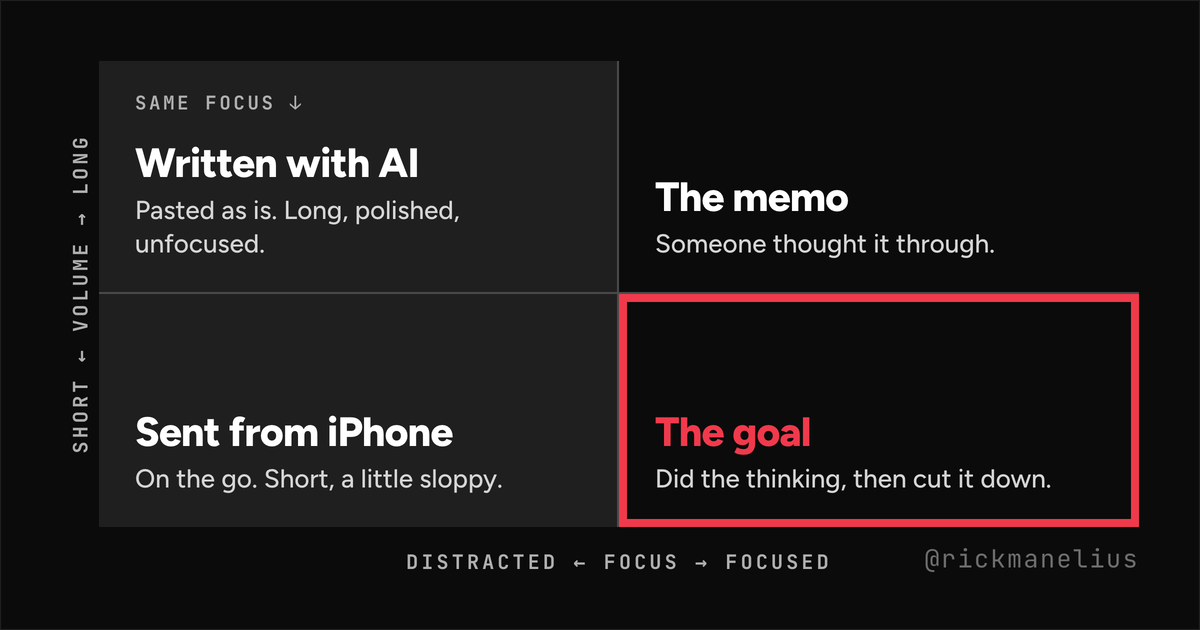
We can visualize this on a 2x2 grid of human FOCUS and output VOLUME.
Summarizing:
Short and distracted: “Sent from my iPhone”
Long and distracted: “Written with AI” (e.g., pasted with no/minimal editing)
Long and focused: a memo someone actually thought through.
Short and focused: the rarest box: essence only (e.g., a Naval Tweet).
AI made volume free (just add tokens!), but human attention is a finite resource.
So if you want your communication to make an impact, aim for short and focused.
Where I Stand
I’ve been a fan of this idea for a while.
I wrote AI;DR to highlight my “You didn’t bother to edit it, so I won’t bother to read it” posture. Although I love Tobi Lütke’s slop grenade term even better.
Humanizer is table stakes. Anything AI touches gets a humanizer pass, which catches the patterns that make text read like a model and fixes them.
Substack made me write an official “How I Make This” statement. Here’s mine, word for word: While I use AI lightly at the end of my process (Grammarly for spelling, grammar, and style suggestions), I type the entire first draft by hand.
At work, I lead with this whenever there is ambiguity. Example: “AI-generated first draft. Human edits: light.” This way my colleagues know whether it’s an early draft OR a final copy.
My Prediction
By Q4 2027, AI writing policies will become a standard at all companies.
This idea already exploded today.
Dylan Field posted Figma’s rule: if you use AI in your writing process, add “written with AI” at the top.
Varun Anand shared Clay’s company-wide AI writing policy, which has a FANTASTIC heuristic.
“More time should be spent writing a document than consuming it.”
And Ishan Goswami went furthest. Quoting Clay, he announced that Exa, an AI company, bans AI-written external comms outright: “If you don’t take the time to write it, why should anyone take the time to read it?”
That’s close to my AI;DR line with one word swapped. Exa says write, but I say edit. I’m fine with AI in the process, as long as a human thought about it BEFORE hitting send.
Finally…
A label won’t rescue slop (if you lie or try to pass off pure AI writing as your own). It’s just a respectful way to tell the reader which box you’re sending from, so they can decide how much of their time to give it.