

I’m SUPER jealous that I didn’t think of this first...
Alas! Hat tip to seclilc for tweeting this gem out two days ago.

I’ve been thinking about it ever since. Why? Because there is growing grumbling among everyone about AI writing. And it’s not just others; it’s me! I am getting to the point where I physically flinch (sometimes dropping my shoulders and hunching, or having a slight eye twitch) when someone I respect sends me unfiltered and unedited AI output.
Look, I get it. It’s Q3 2026, and we should expect that everyone is utilizing AI at SOME point in their process (sourcing ideas, creating outlines, refining prose, etc.).
However, I have a new policy.
If you’re not bothered enough to review and edit it...
...then I’m not going to bother reading it.
Yes, there are certain situations in which we should expect 100% AI-generated copy. Customer support would be a perfect example. We’re not looking for artisanal “did you make sure to reset your phone” style dialogue.
But if you’re my colleague and we’re in a Slack discussion and you post a wall of Claude output, then I’m afraid I received a different message than you intended.
The same is true for people’s newsletters and social content. It’s your name on it; are you proud of the prose and weird AI-isms sprinkled throughout it? If so, great. But I can ask Claude directly if I wanted to.
TL;DR (too long; didn’t read) was the solution for social media.
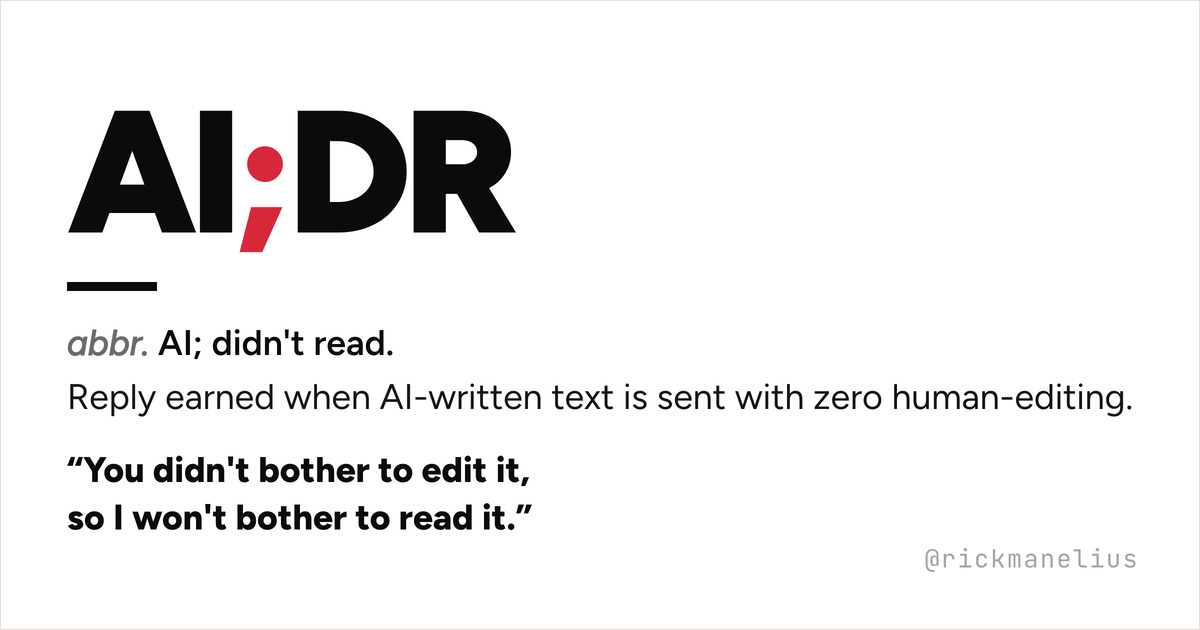
AI;DR (AI; didn’t read) is the solution for AI slop.
May you embrace this policy yourself and seek out those willing to care enough to prioritize a human touch when they talk to you.
Updates
Update 1 2026-08-17: Daniel in the comments shared a wonderful website dontpastetheai.com. Amazing. I especially loved the Take me to the Angry Version version. The intro header says it all.
Update 2 2026-08-18: This made it to #1 on Hacker News on 2026-08-18 with >600 comments. It apparently struck a cord.
Update 3 2026-08-27: Given the popularity of AI;DR, I created graphics that you can use to spread the word!
Graphics
Dictionary Versions
Poster Version
This is great and needs to be paired with the equivalent of "let me google that for you", because some people err on the other side and interrupt and ask you for something that they could have just asked chatgpt for.
People have a website for this: https://dontpastetheai.com