

When we moved to Oklahoma, the welcome came with the following warning:
The people are REALLY nice.
Making friends is REALLY hard.
Strange, yes? But stick with me.
Oklahomans are genuinely, reliably nice. Like SUPER nice. It’s one of the things I love most about living here.
On any given day:
Every stranger will wave and say hello.
The guy at the coffee shop asks about your weekend (and genuinely waits for the answer).
Then they go home to hang with friends they’ve had since the third grade.
That last part was what the warning was about. Most people here have been here forever. They’ve got their people, their church, their standing Friday-night plans, and they are not shopping for anyone new. So you get five friendly minutes (and rarely a sixth). And you’re never invited to hang out or join the BBQ. The friendliness is real. There are just no open seats at the table.
For a while, I took it personally. Then I saw the “nice vs. mean” meme.
Nice vs Mean
You’ve probably seen it, and it basically divides the country into 4 quadrants:
Northwest: “acts nice, is nice”
Northeast: “acts mean, in mean”
Southeast: “acts nice, is mean”
Southwest: “acts mean, is nice”
Yes, it’s a gross over-generalization (to the point where you can find different conflicting versions of this meme!). Still, there is some truth to it.
I lived in Boston from 1999 to 2009, and everyone just felt angry all the time. However, when you actually got through to someone, they were as nice as can be. Then there’s the stereotype of the southern sorority girl, who is as outwardly friendly but secretly judging you.
I personally disliked the particular comparison because I feel “meanness” was the wrong dimension to score, so I made a different grid.
Two New Axes: Approachability & Depth
Approachability. How easy it is to get in the door.
Depth. Whether anything’s on the other side of that door.
The niceness label hid this from me: the two move independently.
A place can be wide open at the front door, but feel empty inside.
Or locked at the front, but it’s full of heart and soul inside.
Plot the places I’ve lived (or know people from there), and they each land in a corner.
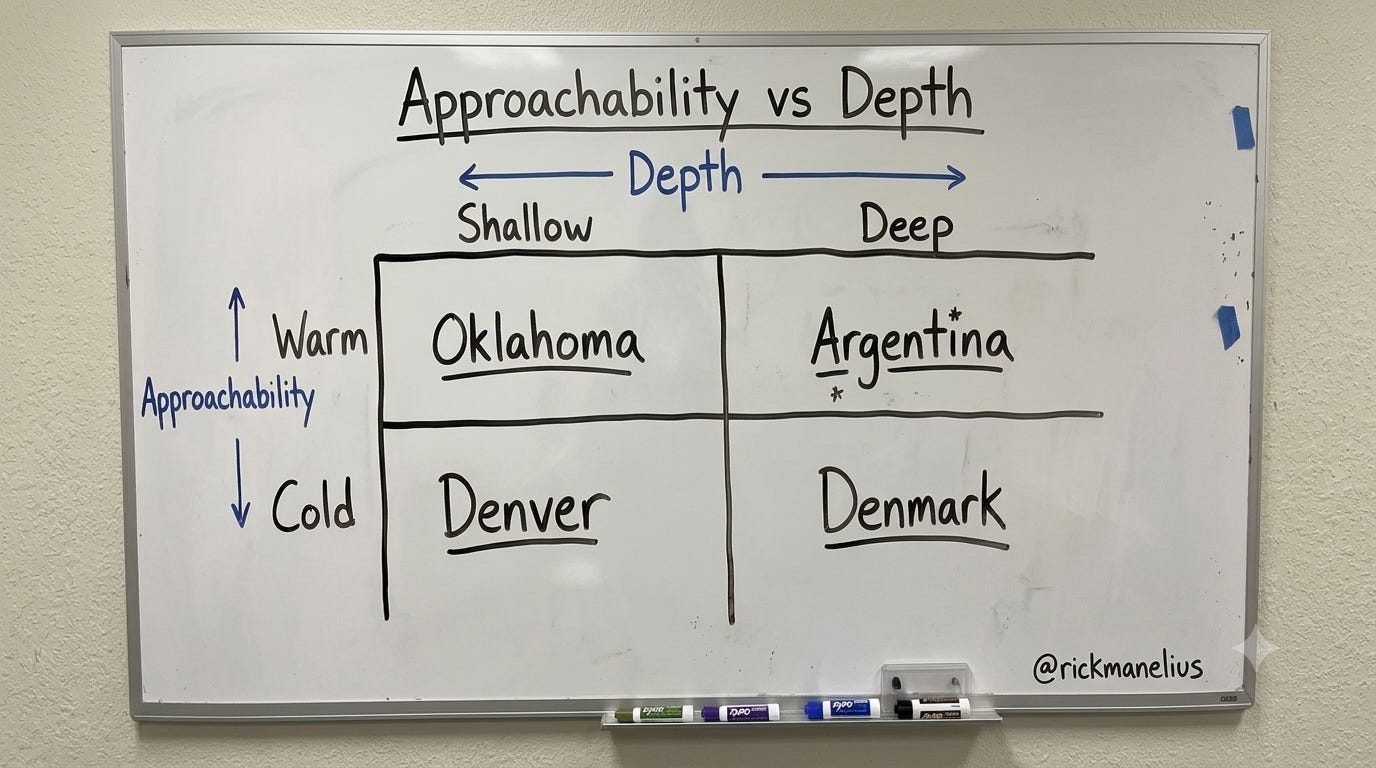
Oklahoma. Low wall, warm welcome. Nothing behind it to hold onto. You’re through the door before you notice, and the door doesn’t go anywhere.
Argentina. The corner everyone wants. Low wall AND real depth. You meet someone at lunch and you’re actual friends by dinner. Open and lasting in the same breath.
Denver. A higher bar, and not much waiting past it either, because half the city is on its way somewhere else. Friendly enough. But nobody’s putting 20 years into a friendship with someone who might leave by spring.
Denmark. This is the one that gave the whole idea its name. A guy in my men’s group told the story: the Danes are tough to crack. Cold at the gate, slow to let you past it. But once you’re in, you are FAMILY for life. He called it “high wall, warm home.” Apparently, others refer to it as “hard shell, soft core.” Well said.
What the map is actually good for
Two things.
One, it explains the friction. That lonely feeling inside a friendly town stops being a paradox once you separate “easy to meet” from “easy to keep.”
Oklahoma is warm and shallow for a newcomer. Naming that, I quit expecting the warmth to ripen into weeknight dinners on its own. It was never going to, and that’s fine. Oklahoma is just the wrong corner for what I came looking for.
Two, don’t take it personally. You can’t force people to be something they’re not.
When you want depth, and you’ve landed in a warm-but-shallow place, what you’re feeling is the local wiring, the default setting of nearly everyone around you. It says nothing about whether you’re worth knowing. And it runs the other way too. The person who reads as cold may have a warm home behind a high wall, and the wall is just how their world is built. Stick around long enough and you find out.
I’ve been on both sides of that.
People who lit up at me for ninety seconds and evaporated. And people who felt shut until, six months later, they turned into some of the best friends I have.
What you want out of a friendship might not match the norms of the place you’re standing in. Worth knowing early, because it changes where you spend your effort.
In a high-wall-warm-home place, you spend it on patience. The wall is the toll, and the home is real, so you pay it.
In a low-wall, shallow place, you stop waiting for an invitation that was never coming. You go build the depth yourself, with the few people looking for the same thing you are.
The map won’t lower a wall or warm a home. It just tells you which one you’re standing in front of, so you stop blaming yourself for the architecture… and you can make a high-agency decision on what to do about it.
Can confirm, Argentina is legit
Love this. Where does this put us (you, me) who (at least) geographically have moved across that plot?
(Obviously the first like had to come from someone from Argentina).